Life in the Calvary: Biography of William A. Raborg Jr.
By Katie Gilbert, 1975
The cavalry is an often forgotten, or ill thought-of, branch of the army. I find it fascinating because I am lucky to be able to see it through the eyes of my great aunt, who was a cavalry officer's wife. Because of the diversity of material, the paper is written in a series of short sketches which will, hopefully, illustrate what life was like in the cavalry during the 1900s."
The cavalry had its shaky beginnings in 1833. The men of the cavalry fought and worked hard, for they had horses to take care of besides themselves. There were exciting and dangerous times—fighting the Indians, the Spanish-American War, and chasing Pancho Villa—but even in peacetime, career officers grew to be heroes. George Patton and Jack Pershing, who is said to have made a fool of himself running after Villa, both started their careers in the early 1900s. The lives of the officers were bold and colorful and deserve recognition.
William A. Raborg, Jr. was commissioned in 1912 and was the youngest commissioned officer at that time. President Woodrow Wilson signed that commission, which declared Bill Raborg a second lieutenant in the United States Cavalry. To receive his commission, Bill had to pass rigid examinations in algebra, trigonometry, geometry, history, a language (German), the Constitution, international law, and English literature. The prospective officer also had a mental and physical check-up before he was considered. At least ten references were necessary; these people had to fill out a questionnaire about the man's morals and judgment. The new officer then gave his choices for the area in which he was most interested and to what regiment he wanted to be assigned. Bill's first choice was field artillery, but he was assigned to the Fifteenth Cavalry and was stationed in succession at Fort Myer, Washington; Fort Leavenworth, Kansas; and Fort Bliss, Texas.
"The regiment performed the usual garrison duty and participated in the activities incident to its peacetime training."
As the quote implies, during Bill's time the officers weren't too busy. They did, however, have two possessions which kept them on their toes. The first was the horse; it was the officer's best companion. Bill's favorite horse once followed him up the stairs of his bachelor's quarters. Each officer had two or three horses, the extra ones called "remounts." The government supplied all the troops with horses, but commissioned officers had to buy their own.
The other necessary possession was the officer's spurs. A true cavalry officer was never caught without his spurs on—his pants, maybe. In their house in Fort Bliss, Bill and Liz had a small cot covered with a spread edged with fringe. One poor visiting officer got his spurs caught in the fringe and fell flat on his face.
Bill and Liz Raborg moved down to Sierra Blanca, New Mexico in September of 1915. They lived in a double house owned by Mrs. Scaife. George and Bea Patton lived next door, and the two couples shared Thanksgiving dinner. When the men had to leave to stop the Mexicans raiding the border, Bill said, "Now after I leave, close the door and push the bureau against it so the Mexicans can't get in while I'm gone."
Villa and the Mexicans provided the only real diversion for the men of the cavalry until World War I. Mexicans crossed often into New Mexico, raiding homes and towns.
"One woman was alone in a house outside of town. There were two small buildings with a dogtrot in between. The Mexicans came to raid her house. She opened the door holding this great big, huge gun and she said, 'Now all right, the first one who makes any attempt to get in this door I'm gonna blow his brains out.' She pointed the gun straight at the closest one and cocked it, and she said, 'I'll pick each one of you off.' It scared them so badly they all turned and left."
Not only the men were brave.
Down in Sierra Blanca, some of the people held big "bailes" (dances) in a two-room house. The back room was used as the nursery and all the babies were wrapped in blankets and lined against the walls around the room. The guns were stacked in one corner. In the front room, a man with a fiddle would play.
Sometimes an officer had a stag party with lots of beer and good food. An orderly was assigned to each officer. He carried a bucket of beer around behind his officer, ready for when it was needed.
Of course, the life of a cavalry officer wasn't all partying and chasing Mexicans. Bill used to lunge his horse on a hot afternoon, and when he'd come back in Liz would complain, "You love the horse more than you do me because you spend so much time with it." He'd answer, "Sweetie, I love you, but that's my job and I have to do it."
The cavalry officer was a dedicated man. The army was still very small then, and every officer knew the name of practically every other officer in the army—certainly in his own branch. It was a very personal army, where people looked out for each other.
In writing, the army seems very cut and dried, impersonal. For example:
"On night of Aug. 1, Troops E and H marched to El Paso, Texas, and entrained morning of Aug. 2nd; proceeded to Finley, Tex. and detrained. On Aug. 3rd, marched to Fort Hancock, Tex. arriving 10:30 a.m. Aug. 4th, marched to Fabens, Tex. arriving 10:30 a.m. Aug. 5th, marched to Fort Bliss, Tex. arriving 12:00 noon. Distance marched 72 miles."
This all seems very simple, but neither the men nor their families knew where they were going or when they would return. (These exercises were employed to keep the troops in shape.) While in Fort Bliss, when their first baby was expected, Bill was sent on one of these maneuvers. Colonel Barney, his commanding officer, sent an orderly down to Liz shortly after Bill had left. He said, "Don't worry, they'll be back tonight." Officers cared about their men and about how their men thought of them. After the birth of Bill Jr., Bill greeted Liz with a handshake. She said, "Is that any way to greet your wife?" He answered, "Well, there are soldiers looking on!"
The usual routine of fort life was to work hard in the morning lunging and exercising the horses and going on details out of the post. After that, there was the necessary stop at the Officers Club before lunch. The men sat around to "rag-chew" and drink a beer. Then they'd have to return after lunch to finish their conversations.
Many of the camp commanders and other officers were well-remembered characters and the subject of stories and legends. Most of these officers were stationed at Fort Bliss, Texas, which was the favorite post of the Raborgs. Many old Indian fighters were stationed in that area. Tommy Thompkins, one of the old crew, had a mustache so long he could tie it around the back of his head.
Captain O'Shay was a stuffy old man. Soldiers, seeing him coming, called out "O'Shay!" Approaching, he'd say, "What did you say?" The answer was, "Officer of the day." They got away with it.
One camp commander prohibited the possession of any liquor on the post. Of course, it became quite a game to see who could get the most booze in.
General Bliss was a real character. He didn't have much hair so he wore a wig. To make it realistic, he had a short, medium, and long wig that he could wear in succession. After wearing the long one for a while, he'd say, "My, I must get a haircut." The next day out came the short wig again.
George Patton was "very colorful," Liz said. "He could do a lot of cussing, but he was a very fine officer. Georgie had a tender heart and was more blustery than anything else." Patton mechanized the cavalry, the process being started by Black Jack Pershing on the Punitive Expedition into Mexico. This took place in the spring of 1916 on President Wilson's orders, which were: "...to go into Mexico and take Villa, but it must do it with scrupulous regard for the sovereignty of Mexico." Old Dodge touring cars seemed to be better than horses, and this was the last major expedition of the horse cavalry.
The army post, or fort, was a complete unit in itself. There was plenty of food; an excellent commissary sent groceries right to the doorstep. Unfortunately, sometimes the cockroaches got to the food first. They appeared in the icebox and often literally covered the floor. A sulfur candle placed on the floor of the kitchen killed them, but unless all cracks were plugged up, the fumes could seep through to other rooms and kill the people, too.
Visiting officers were treated to a big hop. An old-fashioned Dayton car, called the "glass wagon," came around to every house to pick up all the guests. Bill and Liz had to know the name of every officer and his wife there and those of the visiting regiments' officers. Liz's job was to memorize the names of the people in the receiving line. She promptly forgot them after she got home.
Life on the fort continued. One of the returns of the 8th Cavalry said:
"The troops of the regiment performed the usual garrison duties and extinguished fires which started in garage of Base Hospital No. 2, Oct. 17th, and hay pile west of Q. M. Store House, Oct. 30th."
Fires caught easily and spread quickly in the dry, windy country of Texas. Once, the men were out on duty and the wind blew the big hospital tent right out of the ground. Men sent out on details couldn't find it, and that lonely tent hasn't been seen since.
The fort was the focal point for all military installations in the area of El Paso. Often, big reviews were held, such as this one:
"On Sept. 21 the troops of the regiment stationed at Fort Bliss participated in a parade and review consisting of all troops in the vicinity of El Paso, Texas."
Liz described them forming long, very straight lines that stretched for at least a mile.
After Fort Bliss, where the Raborgs were stationed from 1915 to 1917, they went to Fort Niagara in New York. There Bill trained new recruits in the mysteries of the cavalry. By Thanksgiving, Bill had received orders to proceed to Fort Leavenworth, Kansas. Ann Lee, their second child, was born there in 1918. Bill had been ordered out to California, and Liz gave birth in the bedroom without the doctor. The doctor arrived later and said, "Mrs. Raborg, thank you for having your baby today. I have orders to go to Europe tomorrow and I wanted to be here when you had it."
The Raborgs had a beautiful three-story house that overlooked the Missouri River. The fort was spread out over a large area, not surrounded by a wall as most people think. Bill attended classes while in Fort Leavenworth; it seemed as though he was always going to school or studying something. All officers had to continue their education while in the army. Some couldn't stand the strain of discipline and such hard work, however, and one officer had a nervous breakdown during the time the Raborgs were in the fort. He had to return home, and the wives packed up their belongings. It wasn't a happy time, but families of the cavalry had to learn to bounce back, and life went on.
From Fort Leavenworth, the family went to Fort Sam Houston in Texas. Then they returned to Kansas, where Bill took some more courses. He was a very dedicated career officer. A captain in the Fifteenth Cavalry, George P. Tyner, termed him "an excellent shot" and "a bold and fearless rider." (Of course, no one is perfect, and in his records Bill states that he was A.W.O.L. for one day, but the Department Commander excused him.)
The war—WWI—involved everyone, and Bill tried many times to go overseas. (The Fifteenth went to the Philippines in 1915, but Bill transferred to the Eighth because of his marriage.)
Finally, in 1925, the Raborgs were transferred to Hawaii and were stationed in Schofield Barracks in the Royal Crown Hunting Grounds. George Patton was also in Hawaii at that time.
Schofield Barracks was situated in the center of the island, and many times the men had to go down to the coast to fight the natives or get more water.
The house that the Raborgs lived in was shaped like a horseshoe, with the dining room on one side and the bedrooms almost opposite. All army wives knew how to shoot, and Liz kept a Smith & Wesson nearby, just in case. One night, when the men were out, Liz heard the screen door to the dining room squeak. That by itself was not suspicious, but it only squeaked when someone was coming in. Out came the .144 and Liz fired in the direction of the noise. She ran to her friend's room, who could not be convinced even with the gun under her nose. The bullet was found, but the only evidence was some crushed grass outside a window.
In the fall of 1927, Liz returned to San Francisco to put the children in school. About two days out of the harbor, Captain Barney, who had also been in Hawaii, came to the room and said, "Mrs. Raborg, I know you're alone with three small children, so I wanted to tell you this. We've had a fire in the hold for two days, and this is our last extinguisher. If it doesn't work, I'll be back to take you to the lifeboats." He didn't come back, so it must have worked. (The third child was Lisbeth, who was born in Fort Sill, where Bill attended school for one year.)
Bill rejoined the family in 1928, but had developed a serious sinus problem in the humid climate of Hawaii. He was ordered to Washington, where he was operated on. Unfortunately, the operation did him more harm than good. He put in four years in the New York National Guard and spent a short time in Florida, but his condition worsened. William A. Raborg, Jr. was mustered out at Fort Sam Houston as a Lt. Colonel of the United States Army. There were no regrets, and Liz says, "It was wonderful and I enjoyed every minute of it."
Even though horses are not used anymore, the cavalry name is carried on. In the war in Vietnam, the cavalry are the airborne infantry.
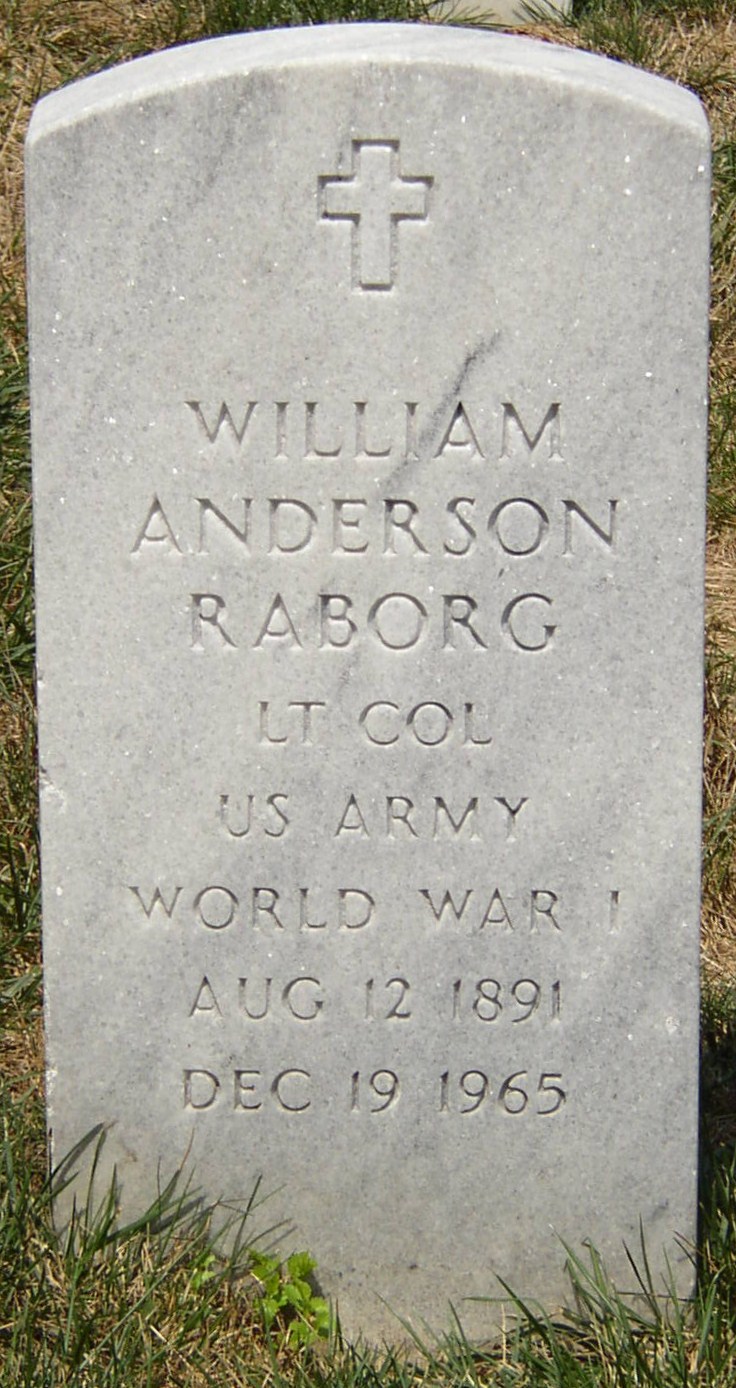
Colonel William A. Raborg's final resting place at Arlington National Cemetery